
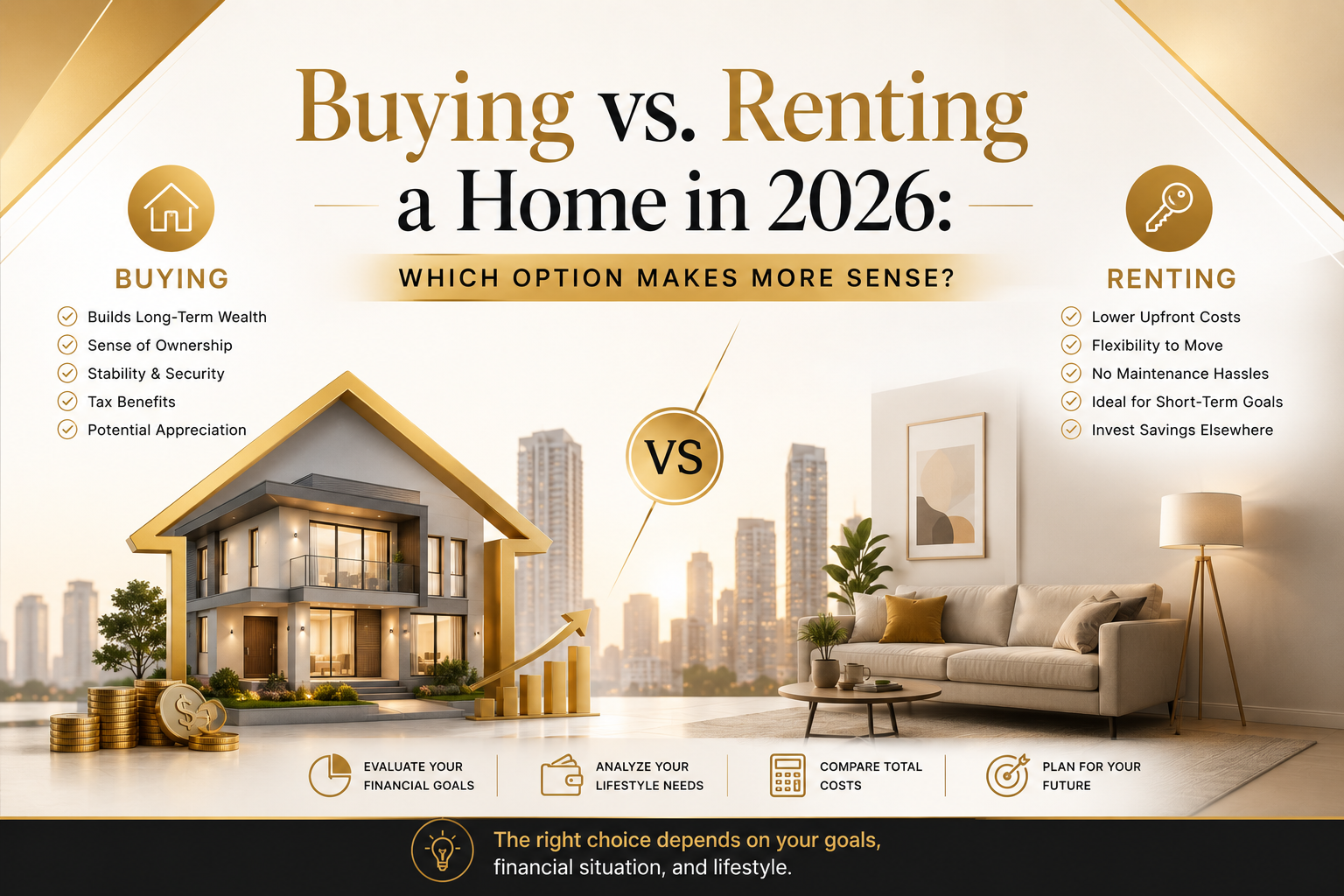
Buying vs. Renting a Home in 2026: Which Option Makes More Sense?
For many Indians, buying a home is a major life goal. But in 2026, rising property prices, changing lifestyles, rental demand, and home-loan costs have made the buy vs. rent decision more complicated than simply comparing monthly rent with an EMI.
The right choice depends on your income, financial stability, location, investment horizon, and future plans.
With the RBI keeping the repo rate at 5.25% in August 2026, borrowing conditions remain relatively stable, although affordability continues to be a challenge in expensive markets, including parts of Delhi-NCR.
Buying a Home in 2026
Buying can make sense when you plan to stay in the same location for many years and have sufficient savings for the down payment and associated purchase costs.
Advantages of Buying
1. You build ownership
Each EMI contributes toward owning an asset rather than paying rent to a landlord.
2. Potential long-term appreciation
A property in a well-connected location with strong employment, infrastructure, tourism, or residential demand may appreciate over the long term. However, appreciation is never guaranteed.
3. Greater control
Homeowners can generally modify and use their property according to their needs, subject to applicable rules.
4. Protection from changing rents
Rent can increase over time, while a homeowner with a suitable fixed-rate loan may have more predictable payments. Floating-rate borrowers should account for possible changes in their EMI or tenure.
5. Long-term security
For families planning to stay in one city for a long period, ownership can provide stability and eliminate the uncertainty of having to move when a rental agreement changes.
Renting a Home in 2026
Renting can be financially and practically attractive when flexibility is more important than ownership.
Advantages of Renting
1. Lower upfront financial commitment
Renting generally avoids the large down payment and transaction costs associated with purchasing a property.
2. Greater flexibility
If your job, business, or family situation may require relocation, renting allows you to move more easily.
3. Access to better locations
Renting may allow you to live in a premium neighborhood where purchasing a comparable property would be financially difficult.
4. More investment flexibility
Instead of committing a large amount of capital to a property, a renter can potentially invest available savings elsewhere. The outcome depends on how consistently those savings are invested and the returns achieved.
Don’t Compare EMI and Rent Alone
One of the most common mistakes is saying:
“My rent is ₹30,000 and the EMI is ₹40,000, so buying is only ₹10,000 more.”
The comparison is incomplete.
A buyer must also consider:
Down payment
Home-loan interest
Stamp duty and registration
Maintenance charges
Property taxes
Insurance
Repairs and renovation
Opportunity cost of the down payment
Potential selling costs
Recent financial guidance has also highlighted why comparing EMI directly with rent can be misleading without considering these additional ownership costs.
Consider the Price-to-Rent Ratio
One useful way to compare buying and renting is the price-to-rent ratio.
For example, if a property costs ₹80 lakh and comparable rent is ₹25,000 per month:
Annual rent = ₹25,000 × 12 = ₹3 lakh
Price-to-rent ratio = ₹80 lakh ÷ ₹3 lakh = approximately 26.7
A high ratio can indicate that buying is relatively expensive compared with renting, while a lower ratio can make purchasing more attractive.
However, this is only one metric. Property appreciation, loan costs, taxes, maintenance, investment returns, and your expected holding period also matter.
Residential rental yields in major Indian markets remain relatively modest, making the rent-vs-buy calculation particularly important.
Buying vs. Renting: Which Is Better for You?
| Situation | Buying | Renting |
|---|---|---|
| Planning to stay 10+ years | ✅ Often suitable | |
| Frequent job relocation | ✅ More flexible | |
| Strong savings for down payment | ✅ | |
| Limited savings | ✅ | |
| Want long-term ownership | ✅ | |
| Unsure about future location | ✅ | |
| Strong local property prospects | ✅ | |
| Expensive property with relatively low rent | ✅ May be worth considering | |
| Family needs long-term stability | ✅ | |
| Prefer investing capital elsewhere | ✅ |
What About Vrindavan, Mathura, Barsana, Greater Noida, Noida & Delhi?
The decision can look different depending on the market.
Vrindavan
For buyers interested in a long-term residence, second home, or property connected to tourism, buying may make sense if the property has good connectivity and location fundamentals.
For people who visit only occasionally, renting or using short-term accommodation may be more practical.
Mathura
Mathura offers a combination of residential demand, local employment, tourism, and connectivity. Buyers should compare the cost of ownership with rental demand in the specific locality.
Barsana
Because Barsana is an emerging tourism-oriented market, investors should take a longer-term view. Buying land or property based solely on expected future appreciation can carry significant risk.
Greater Noida
Greater Noida provides a wide range of residential options and continues to benefit from infrastructure and NCR expansion. Buyers should compare the EMI with prevailing rents in the specific sector rather than relying on city-wide averages.
Noida
Noida is a more established market with employment centers, commercial development, and established infrastructure. For buyers planning a long stay, ownership can be attractive, while renting may make more sense for professionals who value flexibility.
Delhi
Delhi’s established infrastructure and strong demand come with higher property prices in many locations. Renting can therefore be financially attractive in areas where purchase prices are significantly higher relative to comparable rents.
When Should You Buy?
Buying may be worth considering if:
You have a stable income.
You can comfortably afford the down payment.
You plan to stay in the property for several years.
The EMI fits comfortably within your budget.
You have an emergency fund after making the purchase.
The property has strong location fundamentals.
You have verified the property’s legal documentation.
You are comfortable with the long-term financial commitment.
When Should You Rent?
Renting may be the better option if:
You may relocate within the next few years.
You don’t have sufficient savings for a comfortable down payment.
The property price is very high compared with its rent.
You want flexibility.
You prefer investing your available capital elsewhere.
You are still exploring which location is right for you.
A Simple 5-Step Decision Framework
Before deciding, ask yourself:
1. How long will I stay?
If you expect to move within a few years, renting may offer greater flexibility.
2. Can I comfortably afford the complete cost of buying?
Don’t evaluate only the EMI. Calculate the total cost of ownership.
3. What is the local price-to-rent ratio?
Compare the property’s purchase price with realistic rent for a comparable property.
4. What else could I do with my down payment?
Consider the opportunity cost of investing a large amount of money in the property.
5. Do I actually want to own this particular property?
Buying a property should not be driven only by the belief that “property prices always go up.”
Final Verdict: Buy or Rent in 2026?
There is no universal winner.
Buy when you have financial stability, plan to stay for the long term, and have found a property that makes sense at its current price.
Rent when flexibility is important, your future location is uncertain, or buying would put excessive pressure on your finances.
For buyers exploring Vrindavan, Mathura, Barsana, Greater Noida, Noida, and Delhi, the best decision should be based on the specific property’s price, rent potential, location, connectivity, legal status, and long-term demand rather than simply choosing between “buy” and “rent.”
The smartest approach in 2026 is simple: calculate the numbers, understand the location, compare alternatives, and then make the decision that fits your financial goals.



Join The Discussion